
Soon I’ll be returning to Peru.
This time I won’t be crying at the airport or carrying a suitcase full of uncertainty. I’m going on vacation, with a round-trip ticket.
“Round trip.” Two simple words that create the comforting illusion that I have control over my life.
In theory that should change everything. Or at least that’s what I tell myself.

Because if my life has taught me anything, it’s that drama rarely arrives when everything is falling apart. It usually appears when things finally begin to feel stable.
This will be the second time I return to Peru.
The first time felt like a Latin version of a Greek tragedy. One-way ticket. Uncertain future. A heart divided between German bureaucracy, which requires three forms just to breathe, and Peruvian spontaneity, which hugs you without asking whether you signed consent.
On the plane I stared out the window half expecting someone to announce that everything had been a misunderstanding and that I needed to go back to my German routine of recycling and arriving five minutes early to everything.
I thought I might never return to Germany.
I told myself destiny would decide. I said it with great solemnity, as if destiny were the immigration officer stamping my passport.
This time it’s different.
I’m not escaping. I’m not returning defeated. I’m simply visiting.
I leave knowing that I’ll come back to Germany.
For the first time in my migrant life, I’m playing the game on easy mode.

And yet the feeling is strangely familiar.
I still don’t fully belong anywhere.
I’m foreign there and slightly foreign here.
A limited edition.
When I first returned to Arequipa after years away, it felt like a movie reunion. Long hugs. Too much food. That overwhelming hospitality that makes you gain three kilos in two days and somehow feel that it’s an act of patriotic love.
Everything looked the same.
And yet everything felt slightly different.
Then the small details appeared. The ones nobody talks about when migration is described with epic music in the background.
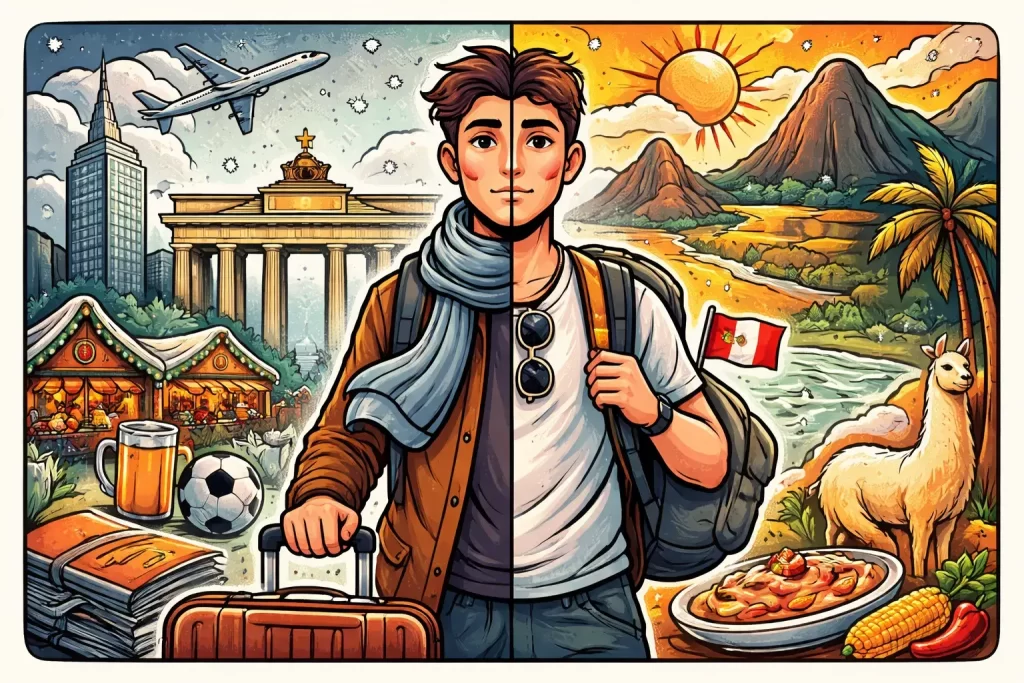
I missed the silence of German Sundays. The famous Ruhe Sonntag, where turning on the vacuum cleaner feels like committing a federal crime.
I missed huge summer parks with lakes, barbecues with vegetarian options and cold beer, and Christmas markets where the cold smells like mulled wine and cinnamon.

And there I was in Peru eating ceviche, tamales, and anticuchos as if cholesterol only applied to other people.
Happy, yes.
But with a strange sensation.
As if my identity had signed a contract with two countries and neither one wanted to cancel it.
When I left Peru, my vocabulary was proudly street-level. I spoke in code. In that language only people from the same emotional neighborhood understand.
When I returned, I discovered the dictionary had been updated without informing me.
New words. New references.
Things that once sounded unacceptable had become trends.
Meanwhile I stubbornly refused to update my linguistic software.
People called strangers “papi.” I didn’t even call my own father “papi” after I turned twelve. How was I supposed to start calling the fruit vendor that?

The funny thing is that in Germany the opposite happens.
Every Christmas I feel an almost ridiculous nostalgia for the family table, the noise, and those endless conversations that begin with politics, drift toward gossip, and inevitably end with food.
I miss what I criticize there.
I idealize what I question here.
The classic migrant paradox.

You’re never quite sure where you’re happier, and you always suspect the grass might be greener on the other side of the ocean.
People think migration is simply moving from one place to another.
It’s not.
Migration means dividing your heart into two time zones.
It means defending your neighborhood with fierce loyalty while secretly admiring the order of the country that adopted you.
It means complaining about the German cold while buying mulled wine in December like a local.
Eventually I understood something uncomfortable.
Migration is not about choosing.
It’s not Germany versus Peru.
It’s about accepting a permanent sense of in-between.
Something will always be missing.
Someone important will always be on the other side of the ocean.
Migration doesn’t allow you to return intact.
It turns you into a cultural hybrid.
You’re no longer fully from here or fully from there.
You become version 2.0 of yourself.

A mixed accent.
A hybrid vocabulary.
An ambiguous identity.
Maybe that’s the real answer.
Home is no longer a point on the map.
Home is where the people you love happen to be.
And over time those people start existing both here and there, as if they also had dual residency.
Germany didn’t leave me when I left.
Peru didn’t leave me when I departed.
Maybe that’s the real homeland of the migrant.
Not territory.
But the elegant, dramatic, slightly neurotic tension between two worlds you’ve learned to love.
And yes, I wrote this in three hours on a Sunday, after doing laundry and cleaning the room and kitchen.
My body still hurts because yesterday I played padel and, much to my surprise, discovered that I’m not that bad at it.
The modern migrant no longer divides his heart only between two countries.
Now it’s divided between nostalgia, Excel spreadsheets, the German supermarket, and a padel match he once swore was far too elegant a sport for him.