
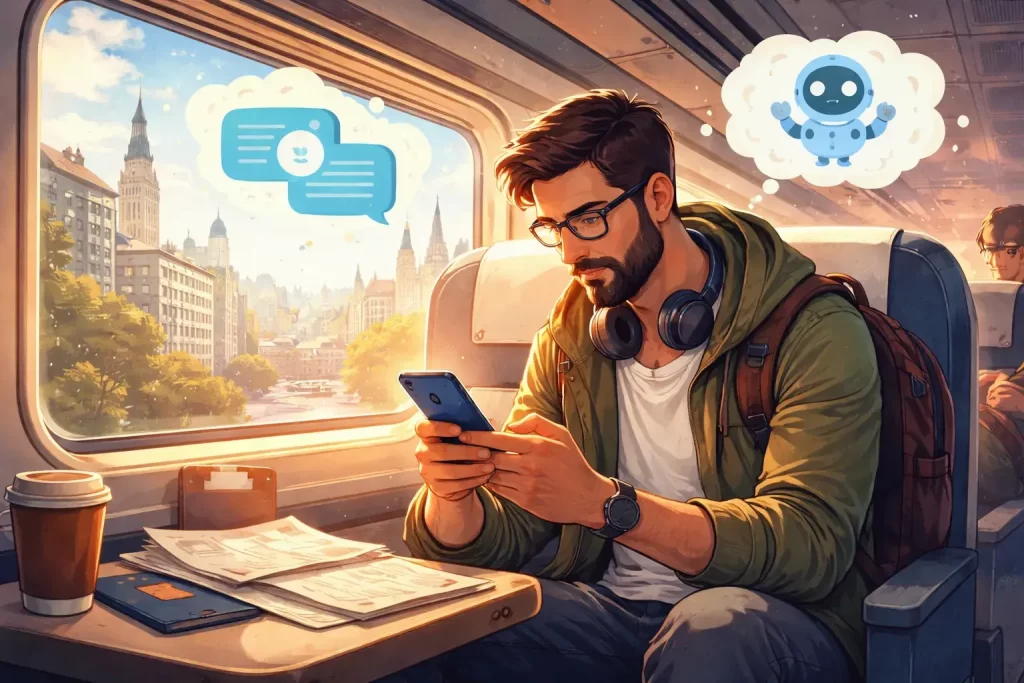

Times change. And when they do, the foreigner is the first to shake. It happened with the internet, it happened with the smartphone, and now it’s happening with AI, which didn’t come to save our souls, but it did come to save us from embarrassment, especially bureaucratic embarrassment.
I, for one, did a big part of my migration the hard way. Not because I’m brave, but because I was broke. Broke on budget and rich in hope, that lethal combination that turns you into a tech Amish with a laptop. A corsair without a ship. A modern professional improvising as if it were still 2002.

Before AI
Back then, migration was an extreme sport with paperwork. You trained by reading forums, blogs, shady PDFs, and advice from people who swore they knew what they were talking about, when in truth they had mostly survived on luck. If you spoke several languages, you were royalty. If you didn’t, you were a scared animal under fluorescent lights.
The first punch was bureaucracy. Then came the full combo: nostalgia, a new language, invisible social codes, and for dessert, that weird feeling of performing all day long. Because migrating isn’t just moving. It’s playing a convincing character in a language that doesn’t really speak your emotions.

I won’t play the martyr. There are wonderful things. But there’s also the slow killer, daily life: a badly written email, a misunderstood requirement, a missed appointment, a form that demands surgical precision when all you want is to live quietly and eat bread in solitude without feeling guilty.
The translator was your cheap lawyer
Before, to write a decent email in another language, almost all of us used translators. And the translator made you look suspicious. You sounded stiff, strange, or straight up like a villain with no PhD.
The lucky ones had a local friend. A hero without a cape. But a friend isn’t a charity office, and over time you start feeling ashamed asking them to review your email number 37 about the exact same issue.
I did what any high functioning obsessive would do. I built templates. An Excel file with links to Word docs. Models for the immigration office, the university, work, greetings, complaints, apologies. A mini operations center to avoid collapsing.

Until one day someone spilled beer on my computer and my perfect system drowned. Since then, I’ve understood that beer has a special talent for erasing organization and dignity at the same time.
The new foreigner
And then AI shows up. Not as magic, but as that assistant that never gets tired, never judges you, and never says “not right now, buddy”. You give it context, you ask for a tone, you tweak two things and suddenly you have an email that sounds like a stable, well integrated person with a future. Even if you’re writing it in pajamas, anxious, and not fully understanding Konjunktiv II.
The difference is brutal. Before, the foreigner learned the language to survive. Now the foreigner learns to direct AI to survive faster, with less social anxiety.

And if you’re like me, the kind of person who loves having everything ready, you can go further and build an agent for the immigration office with a formal tone, one for the university with surgical politeness, one for work with controlled ambition, and one for friends with humanity, which is the hardest thing to fake in German.
AI doesn’t integrate you. It doesn’t hug you. It doesn’t give you friends. But it removes a massive stone from your shoe: language as punishment. And when you migrate, having even one stone removed is a luxury.
The digital pensieve
Like Harry Potter’s Pensieve, AI lets you drop an awkward scene into an imaginary bowl and look at it calmly, without breaking into a cold sweat. You use it to dissect intercultural moments that, in real life, leave you stuttering.
Like when you make an absurd joke about flying cats and nobody laughs. You, convinced you were brilliant, get awkward too. So you ask AI why your joke left the room in tears, and it gives you something sensible. In Germany, humor tends to be drier, more literal, less cruel. And then, as if the cables finally connect, you understand why Johannes at university looked at you oddly and then vanished as if you were just another form.

Now, careful. AI is not a life coach. It doesn’t have answers for everything, and certainly not for the emotional chaos we don’t even understand ourselves. It can help you think, organize, rehearse conversations, find plausible cultural explanations. But it’s not an emotional refuge or pocket therapy. If you turn it into a psychological crutch, you’ll probably end up even more confused, just with better written paragraphs.
Conclusion
Today AI is, at the very least, a practical tool to integrate with fewer bumps in a new culture. It doesn’t perform miracles, but it helps. And the real limit isn’t the technology, it’s what you need and the ingenuity you have to ask for the right thing.
Now, if one day Skynet decides humanity has had enough, I just want something on record. I was always polite. I always wrote my prompts with good morning and please. And I said goodbye like a decent person. Let the minutes show it, in case the robots keep archives.

This text, by the way, took me almost four hours. I started on Friday with a brainstorm, made progress on Saturday before going to see The Housemaid, and finished it on Sunday while doing the laundry. Modern life is like that. You reflect on the future of the species while separating white clothes.