
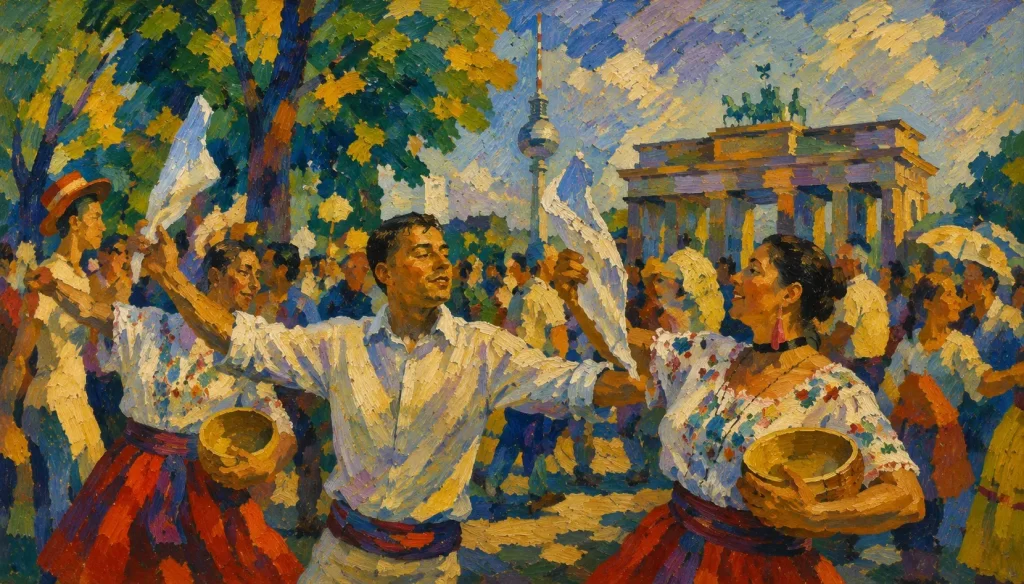

The Karneval der Kulturen returns this 2026 from Friday, May 22 to Monday, May 25 and, like every year, the moment I saw the dates I immediately did something completely irresponsible for my financial stability. I bought my tickets to Berlin before thinking too much about it.
Because Germany has beautiful events.
And then there’s this carnival.
Four days during which Berlin stops feeling like Germany and turns into a glorious mix of salsa, drums, beer, grilled food smoke, different languages and people dancing as if Monday simply did not exist.
Every year I tell myself I’m too old to walk ten hours straight, sleep badly and destroy my knees dancing cumbia.
And every year I come back.
Things You Should Know Beforehand
The Carnival of Cultures takes place during the long Pentecost holiday weekend and practically takes over an important part of the city. During those days there are concerts, food fairs, exhibitions, dance performances, street theater and a massive multicultural parade on the second-to-last day.
Most activities are free, which explains why Berlin suddenly fills up with tourists, backpackers, artists, nostalgic Latinos, spiritual Europeans and people who clearly haven’t slept since Thursday.
My recommendation is simple.
Book accommodation early.
Because once carnival season gets close, hotel prices rise with a speed that would make any low-cost airline proud.
The official information and program are usually published on the carnival website, although Berlin has the curious ability to organize chaos until the very last minute.

It Feels Like Traveling
You start by listening to medieval European music while eating crepes made by people dressed as if they had just escaped from a 15th-century tavern. Then suddenly you find yourself watching African dances, trying Cameroonian food and hearing drums that somehow synchronize with the heartbeat of the entire street.
After that you arrive in Asia, the Middle East, the Caribbean or the Balkans and, at some point, your brain stops understanding exactly where it is.
But of course, I always end up drifting toward the Latin area.
And that’s where something strange happens.
For a few hours Germany disappears.

Street vendors appear everywhere, the smell of grilled meat fills the air, salsa and cumbia start playing, old reggaeton comes back from the dead and people suddenly begin speaking far too loudly by German standards.
Everyone dances with everyone.
The Peruvian woman dances with the shy German guy.
The Colombian dances with the Japanese girl.
The Italian tries to dance salsa and destroys three relationships in the process.
And somehow, even after years of living outside Latin America, you begin feeling something dangerously close to being back home.
The magic lasts until nighttime, when the private concerts and heavier parties begin. In my case, I always end up happily lost at some psychedelic cumbia concert, wondering how exactly I managed to dance for six straight hours again.
Mea Culpa
I have to admit something.
The carnival offers far more than I actually take advantage of.
There are classical music concerts, art exhibitions, cinema, theater, circus performances, activities for children and every possible kind of cultural expression.
And yet, I still spend most of my time at the Latin events.
I suppose every migrant has an emotional weak point.
Mine apparently involves salsa, beer and people dancing in the middle of the street as if nobody had work the next morning.
If you go to the carnival, I recommend checking the official program and exploring different areas. Berlin rewards curiosity.
Meanwhile, I will probably continue pretending I’m “discovering new cultures” while dancing cumbia for the third consecutive night.

Destroying Sneakers
The most intense concerts usually start in the afternoon and from that moment everyone begins dancing.
Even the people who clearly have no idea what they’re doing.
And honestly, that is the best part of the carnival.
Nobody dances to impress anyone. People dance to emotionally survive the German year.
I’ve seen Germans dance salsa with the same concentration they use when filling out paperwork at the Bürgeramt. I’ve also seen completely exhausted tourists continue dancing simply because the perfect song started playing at the perfect moment.
And yes, I destroyed a pair of sneakers.
Literally.
The sole died on the first day and my legs stopped functioning properly on the second. I walked through Berlin like an Andean war veteran, exhausted but happy.
If you plan to go, carry as little as possible. Small backpack, light clothes and comfortable sneakers. Also stay hydrated because between the dancing, the heat and the beer, the carnival can quickly become a multicultural extreme sport.

Berlin, Always Berlin
And when the noise finally becomes too much, Berlin changes personalities.
You can escape to a quiet café, walk around Kreuzberg or end up in some hidden restaurant serving incredible food at two in the morning.
That’s what fascinates me about Berlin.
It never tries to be perfect.
It prefers being chaotic, exaggerated and strangely honest.
Besides the carnival itself, I always find Latin concerts, absurdly interesting bars, Spanish-language comedy shows or random corners where all of Latin America seems to have gathered to discuss politics, football and toxic relationships.
Getting bored in Berlin during that weekend is practically impossible.

The Parade
On the second-to-last day comes the huge multicultural parade.
Every country tries to showcase the very best of its music, costumes and energy. Some years certain groups stand out more than others depending on budget, organization and pure determination to impress the crowd.
Brazil almost always steals the spotlight because it manages to turn Berlin into a tropical mini version of Rio for a few hours.
But honestly, part of the charm is never knowing who will surprise you the most.
That said, I must confess something.
I almost always arrive late.
Not because of cultural rebellion.
Simply because after three days of carnival my body officially goes on strike.
If you still have enough energy to wake up early, try getting there ahead of time and finding a good spot. It is completely worth it.

Conclusion
I’ve been to many events in Germany.
Perfect Christmas markets. Impeccably organized festivals. Fairs where everything works exactly the way it should.
But very few have a soul.
The Carnival of Cultures does.
Because for a few days, Berlin stops acting like Germany and starts behaving like the entire world squeezed into the same streets.
And maybe that’s why so many migrants keep coming back every year.
Not only because of the music or the food.
But because, even if only for one weekend, you stop feeling like a foreigner.